
Why we design architecture, interiors, lighting and technology together
Designing how a home feels
A living room is rarely used in just one way.
It can be a place for conversation with friends, a quiet corner for reading, a space for family, an evening spent watching a film, or simply somewhere to sit at the end of a long day.
The lighting should respond to all of these moments.
Not by adding more lights, but by giving the room the ability to change.
Because good lighting does more than illuminate a room.
It influences how we experience it.
Lighting should follow life
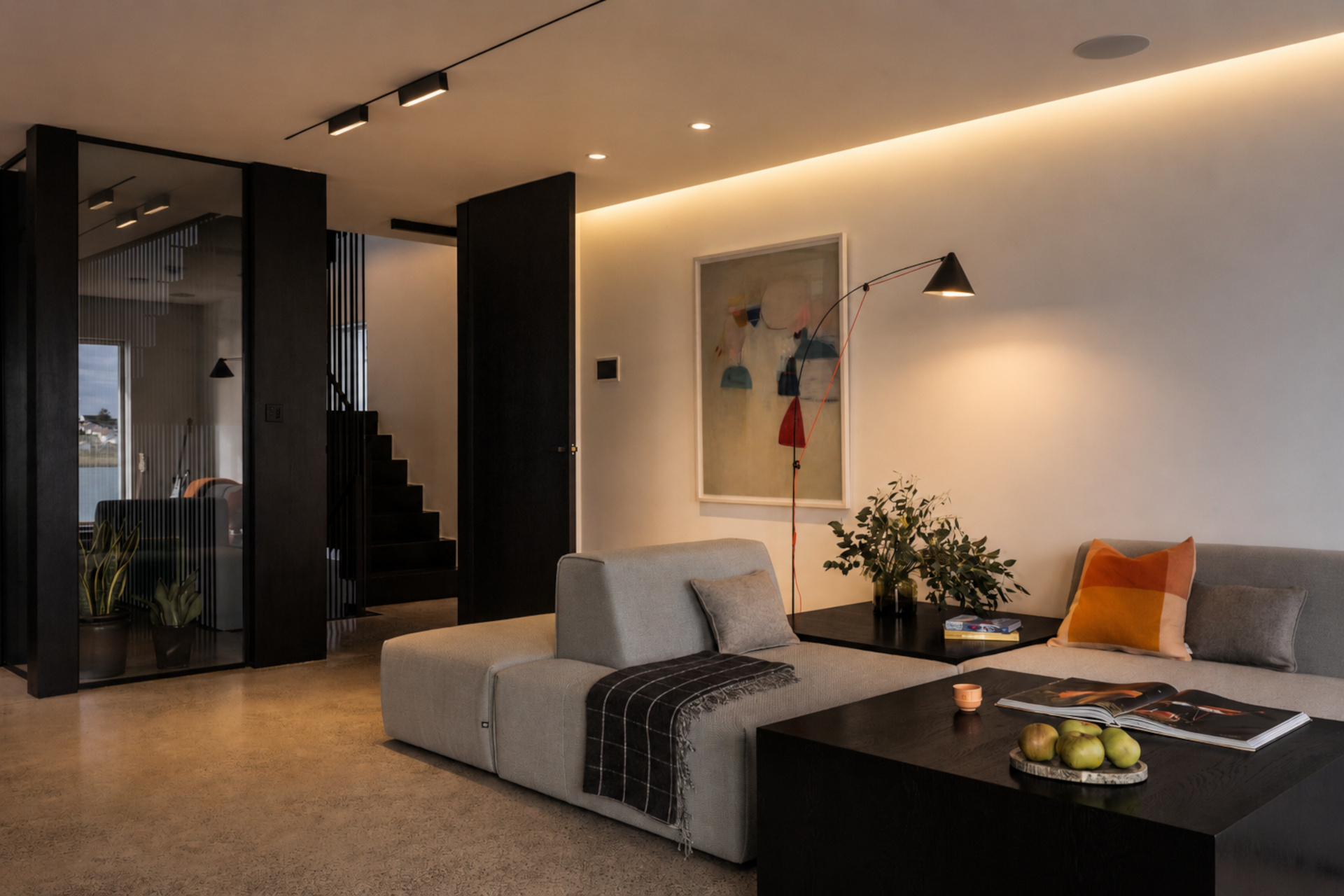
The most comfortable living rooms rarely rely on a single source of light.
Instead, several layers work together.
Some provide enough light to move comfortably through the room.
Others illuminate specific areas, such as a reading chair, coffee table or dining area.
And some are there for no practical reason at all.
They simply create atmosphere.
A wall washed with soft light.
A beautifully textured piece of timber.
A piece of artwork.
A bookshelf.
A plant.
These smaller moments of light give the room depth and allow the atmosphere to change throughout the day.
From daylight to evening
Natural light is the first layer of any lighting design.
As the sun moves through the room, colours, textures and materials change with it.
Timber becomes warmer.
Textures become more visible.
Shadows move across walls and furniture.
A well-designed lighting scheme should complement this natural rhythm rather than compete with it.
As daylight fades, artificial light gradually takes over.
This transition is important.
A living room should not suddenly become bright simply because it is dark outside.
Instead, the atmosphere can become softer and warmer.
This is where carefully considered lighting begins to make a real difference.
Warm light creates a different kind of comfort
For living spaces, we often favour warm light around 2700K–3000K.
At 2700K, light becomes softer and more intimate, particularly when combined with timber, natural fabrics and warm neutral colours.
At 3000K, the atmosphere remains warm while providing a slightly cleaner and more contemporary quality.
The choice is not simply technical.
It is about how the room should feel.
A brighter, cooler environment may help with concentration during the day.
A softer, warmer scene can encourage us to slow down in the evening.
The same room can support both.
Light should not come from everywhere
One of the most common mistakes in residential lighting is trying to make every part of a room equally bright.
This often creates a space that is functional, but flat.
Instead, we prefer to create areas of light and shadow.
A pendant above a coffee table.
A softly illuminated wall.
A directional spotlight highlighting artwork or architectural detail.
A floor lamp beside a favourite chair.
A concealed source of light within joinery.
Together, these create a more natural visual hierarchy.
Your eye is gently guided through the room.
And the space feels calmer.
Lighting can reveal the architecture
Lighting becomes particularly powerful when it is considered at the same time as the interior architecture.
A beautifully designed piece of joinery can become almost architectural when softly illuminated.
A textured wall can gain depth.
A carefully selected artwork can become a focal point.
Timber can appear completely different in the evening than it does during the day.
This is why lighting should not be an afterthought.
The position of a light, the direction of its beam and the quality of the light should be considered alongside the architecture, materials and furniture from the beginning.
Technology should disappear into the background
Technology can make this experience even more intuitive.
Rather than switching individual lights on and off, different lighting scenes can be created around the way the room is actually used.
One scene for everyday living.
Another for entertaining.
Another for watching a film.
A softer setting for reading.
And an evening scene with only selected areas of the room illuminated.
The technology remains in the background.
What the homeowner experiences is simply a room that feels right.
Choosing the right lighting
The decorative fitting is only one part of the decision.
We consider the quality of the light, the beam angle, glare, colour temperature, colour rendering and how the fitting relates to the architecture.
Sometimes we need a fitting that remains almost invisible, allowing the light itself to become the main element of the composition. In other spaces, the fitting can become part of the character of the interior.
It is equally important to consider how the fitting will perform over time – whether it will continue to support the way the homeowners live and remain consistent with the timeless character of the interior.
For this reason, we look beyond appearance and consider the quality of the light, proportions, materials, finish and the way the fitting works within the wider space.
The important point is not which fitting is fashionable.
It is why it has been chosen.
A home should change with You
The best lighting design is not something you notice every time you walk into the room.
You notice it when you sit down and feel comfortable.
When the evening feels calmer.
When a favourite chair becomes the perfect place to read.
When friends arrive and the atmosphere changes effortlessly.
When the lights dim and the room suddenly feels more intimate.
This is what we mean by designing a home around the way you live.
Lighting is only one part of that process.
Architecture, interior design, materials, furniture, lighting and technology all influence the same experience.
When these elements are considered together, the result is not simply a beautifully designed room.
It is a home that feels effortless to live in.
At Galway Interior Design, we believe the most successful homes are created by considering these decisions together from the beginning.
Because ultimately, good design is not about how many lights you have.
It is about how your home makes you feel.